Thursday, 31 March 2011

WEEK 4 - Visual Language

Sight = trust, power through flirting, eye contact, visual reassurance. We loose power when we can not see as we don't have the power to look at something or make someone look at us and we are unable to look away.
We also judge people on how they look, for example politicians employ people to make them look trustworthy and powerful. So the way they dress and physically conduct themselves communicates to us visually.


The camera has long been used to create visual compositions to portray meaning, they can be used to show heightened and fleeting moments.  A photographer who did this was 'WeeGee' Arthur Fellig.


Weegee got his name because he was always the first to a scene with his camera. This enabled him to capture the moments in time that nobody else was. Weegee would photograph murder scenes or any form of disaster like in the images above. He would capture moments in time that could communicate to the viewer the feeling or experience of that moment whether it be kids playing on the street or a building ablaze. His photography captured true moments in urban society between 1930's and 40's.


Emmett Till was murdered in Mississippi at the age of 14 after reportedly flirty with a white woman. A few days later the womans husband and his half brother took Emmett to a barn where they beat him and gouged out one of his eye's before shooting the boy. His body was then thrown in the river found three days later. Emmett's mother insisted on a public open casket funeral to show the world the brutality of the murder. Tens of thousands attended the funeral and the image taken of his casket shown bellow was published in newspapers and magazines. This murder is considered a major contributor to inspiring the African-American Civil Rights Movement. 


Publicising the images of his mutilated body in the casket brought power to the situation. Words can not describe what these images communicate.

Robert Frank


This image titled 'Trolley' by Robert Frank makes a statement it is not simply an image of individuals travelling on public transport, the image has social, cultural and historical meaning behind it. It portrays the culture of the time in which black and white people were forbidden to mix together. This is shown through the image showing the black and white sectioning off on public transport. The coloured section was always at the back communicating there important at this time in society. Robert Frank has illustrated and summed up a period in culture though one image just using visual communication. 

Rosemary Laing


Rosemary explores conceptually based photography as seen above. She is another example of a photographer who uses an image to visually communicate an idea very effectively. 


Tuesday, 29 March 2011

Vocabulary

Authenticity - Undisputed credibility.  


Appropriation - To adopt, borrow, sample aspects of work.


Avant-garde - Any creative group active in the innovation and application of new concepts and techniques in a given field. 


Binary opposites - The oppositions through which reality has traditionally been represented. Eg. male/female, nature/culture, mind/body.


Bricolage - A construction made by whatever materials at hand. Something created from a variety of available things. 


Broadcast Media - Broadcasting is the distribution of audio or video signals which transmit programs to an audience. The audience may be the general public or a relatively large sub-audience, such as children or young adults. 


Capitalism - An economic and political system in which a country's trade and industry are controlled by private owners for profit, rather than by the state. 


Cinema verite - A style of film making that stresses unbiased realism and often contains unedited sequences.


Classical art - Conforming to the artistic and literary models of ancient Greece and Rome.


Code (in visual culture) - In communications, a code is a rule for converting a piece of info (for example, a letter, word, phrase, or gesture) into another form or representation (one sign into another sign), not necessarily of the same type.


Colonialism - A policy by which a nation maintains or extends its control over foreign dependencies.


Commodification - The commercialization of an object or activity that is not inherently commercial.


Connoisseur - A specialist of a given field whose opinion is valued; especially in one of the fine arts, or in a matter of taste.


Commodity Fetishism - A state of social relations that occur in a capitalist market based societies. The social relationships are transformed into an objective relationship between commodities or money.


Connotative Meaning - All the social, cultural and historical meanings that are added to a signs literal meaning. Relies on the cultural and historical context of the image and it's viewers lived, felt knowledge of those circumstances. Connection thus brings to an object or image in the wider realm of ideology, cultural meaning and value systems and a society. 


Thursday, 17 March 2011

Week 3 - culture in society

CULTURE: The totality of socially transmitted behavior patterns, arts, beliefs, institutions, and all other products of human work and thought. (www.thefreedictionary.com)

There are two forms of culture, high culture and low culture. High culture would be philosophy, intellectual pursuits or arts and low culture would be the everyday consumption of goods and services, popular activities, entertainment and sports.

Our culture is reflected in the objects, services, communities around us. An example of culture being shown through possessions is children's toys, in particular girls dolls. The article 'Oh, You Beautiful Doll' (The Weekend Australian Magazine February 12-13 2011) written by Greg Callagham talks about young girls growing up with toys and role models endorsing the idea that you need to look gorgeous and sexually attractive. "These dolls foster impossible-to-attain body images...", the dolls all have super skinny waists, pouty lips, big eyes which the average female doesn't look like. The article also says, "dolls with flawless bodies and skimpy cloths are priming girls for premature sexualisation..." which i agree with. You just have to look at what young girls are wearing today to see the evidence of this.


The denotation of barbie is blond hair, pouty lips, big blue eyes, large bust and tiny waist. The connotation of this is innocence, compliance, submission, manipulation, sweetness and unquestionable love.
This sexualisation of women is see as power, girls are now educated and encouraged to gain education in order to gain power and status in the workforce. Although they are still seeing these models as role models thinking they need to look a certain way to get power and status.
So much of our culture has changed but the sexualisation of women has consistently stayed the same.


Advertising

Cartoons/Animation

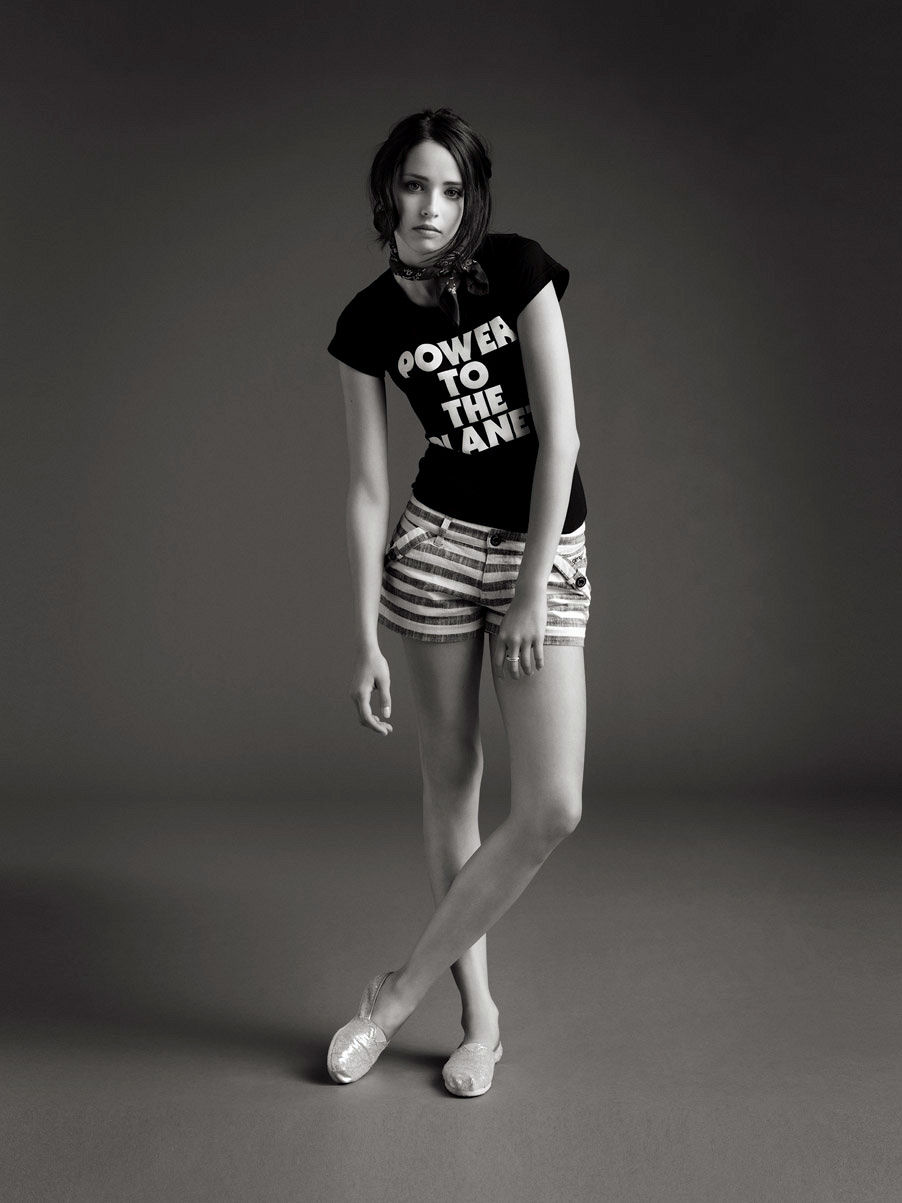
Fashion

Celebrities

Wednesday, 9 March 2011

Week 2 - The narrative in visual communication

Artists have always grappled with ways to portray their stories in a way that will engage an audience. One way stories can by told is through cinema and about 7 billion people a year will pay money to view these movies. There has always been a need to tell and portray stories and over the centuries this has been done in different ways such as stone carvings, paintings and cinema.

The beautiful thing about being able to tell stories through visual language is that they can be understood by many people and not only those who can read. As time went on the stories were able to be represented and told better. For example in Greece the story of Odysseus was capture through a sculpture and we were able to see the emotion in the moment just before he was about to be stabbed in the eye. By being able to see emotion in the story made it more intriguing to the viewer. These stories can have many different purposes such as to entertain, communicate power, political motivations or tell history. Since the early stories from Greece and the Middle East which were only stone carvings we have seen cinematic effects being used. Such as in the Trajans column in Rome various view points have been used to capture the moment from different angles.

Linguistics views communication as the production of meaning and suggests the one message is going to mean different things to different people depending on different factors.
It focuses on the receiver and the social, political and economic environment in which they live. This theological approach to design applies not only to graphic design but to fashion designers, product designers, illustrators and architects.

Noise - The unnecessary in an image.
Redundancy -  What doesn't need to be there.
Paradigm - A set of views, concepts, assumptions or practices that create a way of viewing reality for the community that holds these views, concepts, assumptions or practices.

week 1 - Images are language

We need visual communication because we are humans who dream, imagine, puzzle and search for answers. There is a hiearachy to the images/art around us:
1. Fine art


2. Commercial art (eg. graphic design)


3. Popular culture (eg. t-shirts, bandcovers)


These codes of images which opporate within a cultures are easy do decode if you live within that culture. There are also subcultures and special interest groups and these codes are always changing.

Semiotics: the study of meaning.

There is a three part method for examining art:
1. Materiality - Each culture has differrent materials available to them and the artist or designer chooses the materials they use.
2. Formalism - Line, colour, form/shape, composition and formal elements.
3. Content (Denotation which is whats in the image and connotaion which is it's meaning)

We are constantly communicating non-verbaly in many different ways:
* The way we wear our hair and cloths, which distinguishes us as belonging to sub-cultures and a particular class, country or opportunity.
*The car we drive.
*The way we arrange the posetions we have chosen for our room/house.
*Facial expresions and body language.
*Tattoos and make-up

our culture has produced many media forms for visual communication to be 'transmitted':
*Television
*Cinema
*Magazines
*Photography
*Road/traffic signs
*Animation
*Music videos

Non-verbal communication can make people feel dislocated from a society or even their own society. Simply by the cloths we wear we can either stand out from society, blend in with society or make a statement. so many images have connotations linked to them so you could be communicating something you didn't even meant to communicate or represent.